City on a Hill Pulse
The Pulse
October 5, 2026·City on a Hill Pulse

Executive Summary
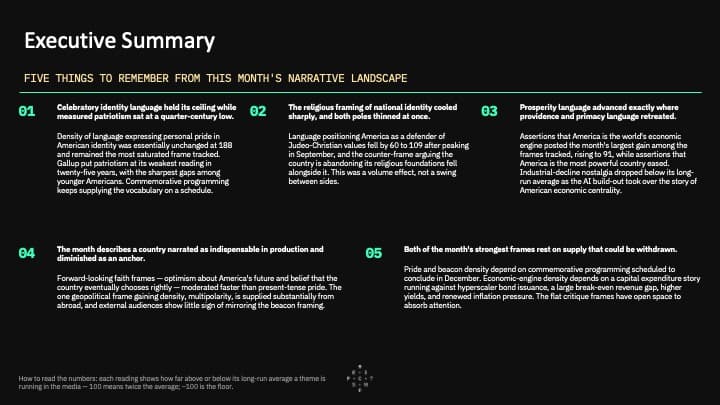
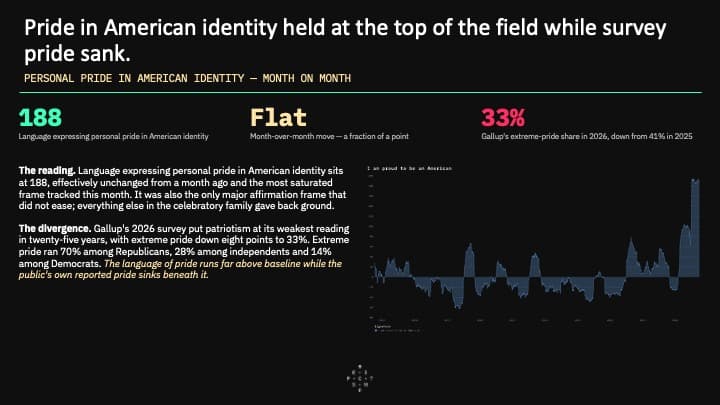
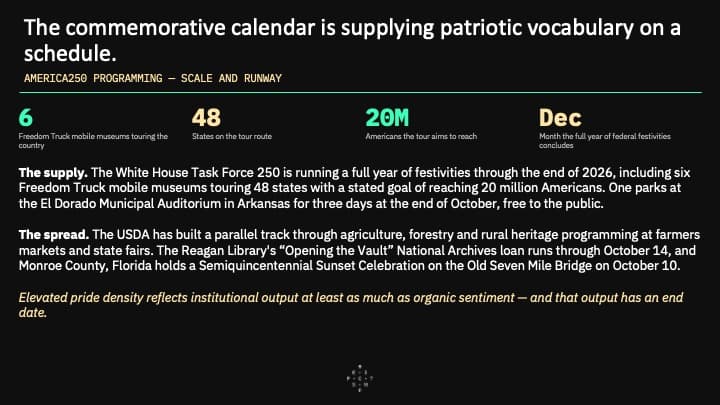
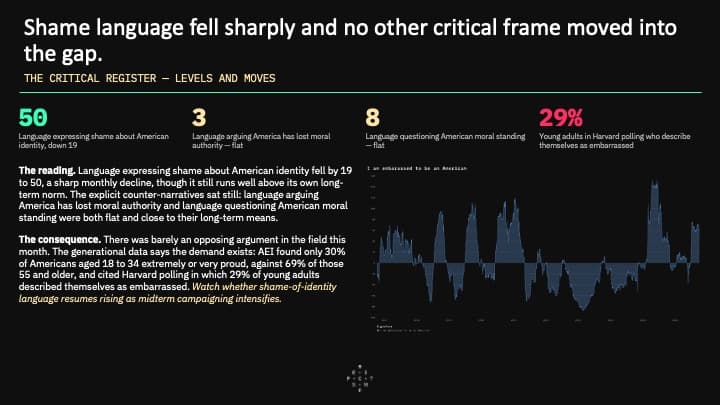
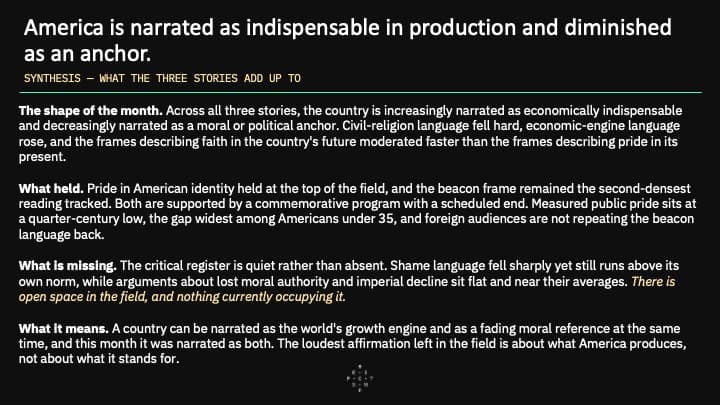
- Celebratory identity language held at the top of the signature set while measured public pride sat at a quarter-century low. Media density of personal pride in American identity was essentially unchanged and remained the most saturated frame tracked, yet Gallup and related polling showed patriotism at its weakest reading in twenty-five years, with the sharpest gaps among younger Americans. The commemorative calendar — Task Force 250 programming, Freedom Truck tours, state and library exhibitions — continues to supply vocabulary on a schedule, suggesting that elevated pride density reflects institutional output at least as much as organic sentiment. Explicit counter-narratives barely registered: signatures arguing lost moral authority or questioning American moral standing stayed flat and near their long-term norms.
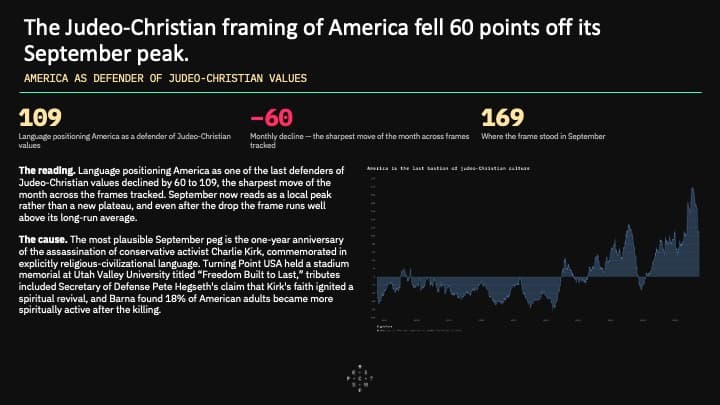
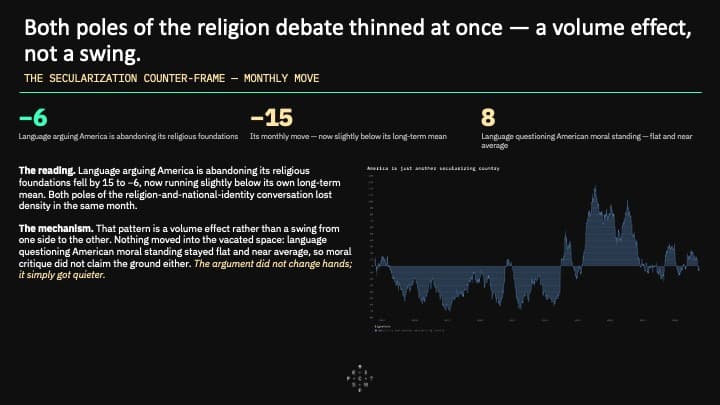
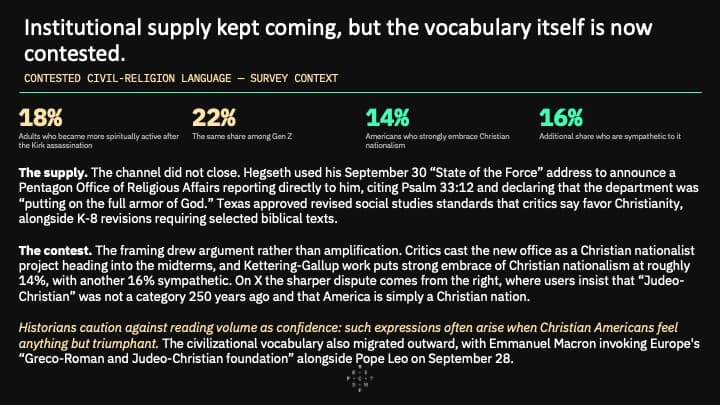
- The religious framing of national identity cooled sharply after peaking in September, and both poles of that conversation thinned at once. Perscient's signature tracking language positioning America as a defender of Judeo-Christian values recorded the largest single movement in the file, and the counter-frame arguing that America is abandoning its religious foundations fell alongside it. This was a volume effect rather than a swing between sides. Institutional supply did not stop — a new Pentagon Office of Religious Affairs, state curriculum revisions, 250th-anniversary prayer programming — but the vocabulary itself is under dispute, including from the right, which may explain why the frame thinned rather than consolidated.
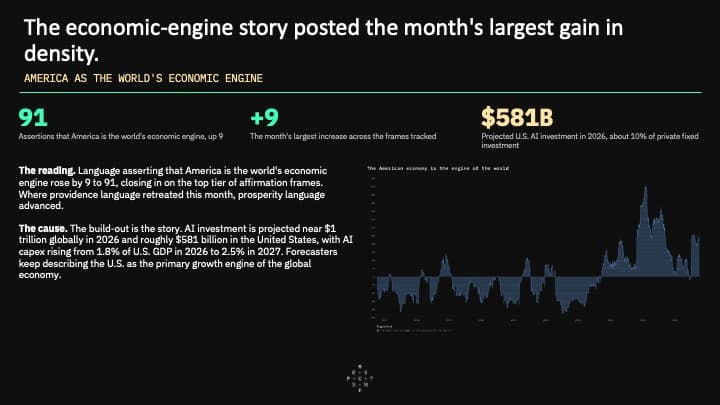
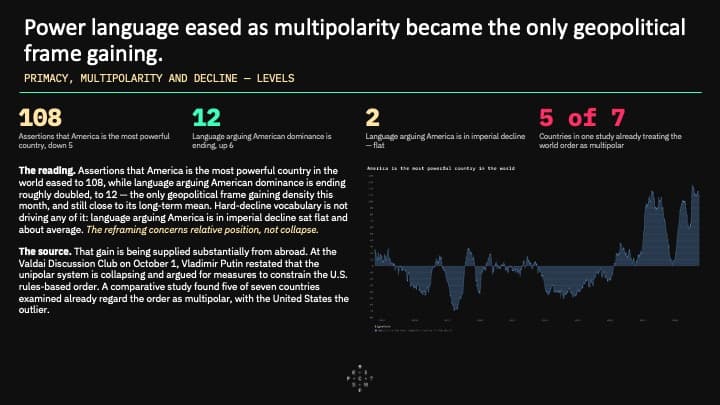
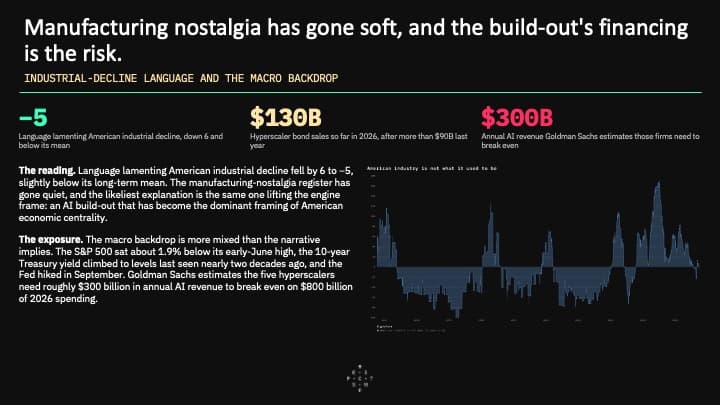
- Prosperity language advanced exactly where providence and primacy language retreated. The signature asserting that America is the world's economic engine posted the file's largest monthly gain, while the signature asserting that America is the most powerful country eased. Industrial-decline nostalgia dropped below its long-term mean, consistent with an AI build-out story that has become the dominant framing of American economic centrality. Hard-decline vocabulary remains absent; the reframing concerns relative position, not collapse.
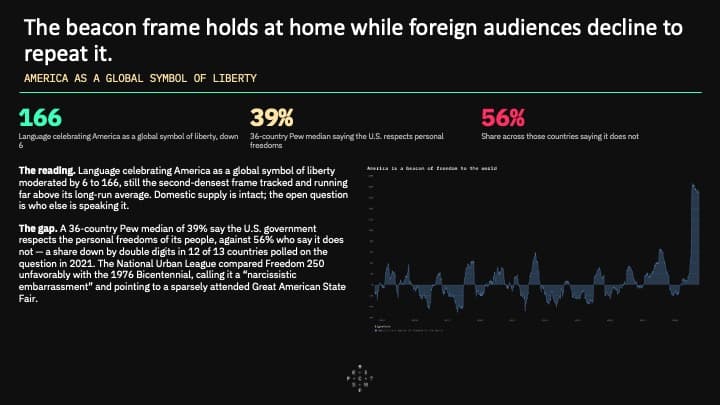
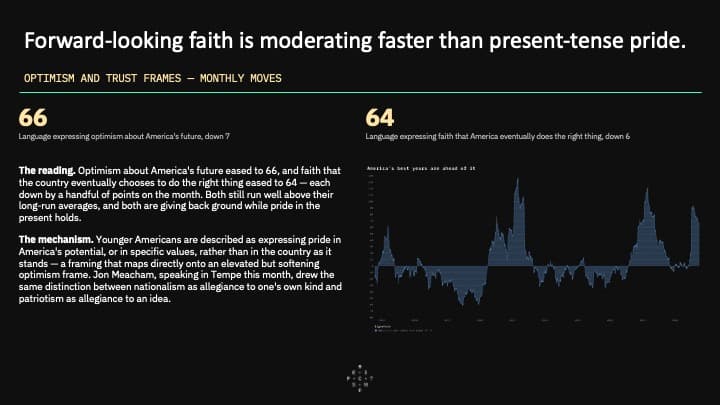
- Across the three sections, the month describes a country increasingly narrated as economically indispensable and decreasingly narrated as a moral or political anchor. Forward-looking faith frames — optimism about America's future and belief that the country eventually chooses rightly — moderated faster than present-tense pride, while civil-religion language fell and economic-engine language rose. The one geopolitical frame gaining density, multipolarity, is being supplied substantially from abroad rather than generated domestically, and external audiences show little sign of mirroring the beacon framing.
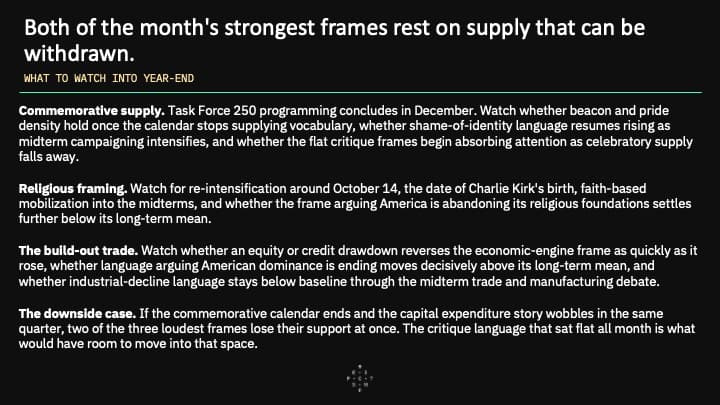
- Both of the month's strongest frames rest on supply that could be withdrawn, which is the central vulnerability to monitor. Pride and beacon density depend on commemorative programming scheduled to conclude in December, and economic-engine density depends on a capital expenditure story running against a mixed macro backdrop of hyperscaler bond issuance, a large break-even revenue gap, higher yields, and renewed inflation pressure. If either support is removed, the currently flat critique signatures have open space to absorb attention.
Last updated: ...