Before the Flood
Epsilon Theory
July 18, 2025·16 comments·Politics
The current administration faces plummeting public support on its signature policies, yet is accelerating those very policies with visible contempt for opposition. Public opinion on immigration has reversed dramatically in the past year, with Republicans themselves shifting toward support, while the government doubles down on enforcement that few want. Something has fundamentally changed in how power relates to consent.
- The mask has come off in ways previously unthinkable. Evil that once hid behind justifications now operates openly, mocking the idea that it needs to explain itself. When leaders stop pretending, they signal they've stopped needing the approval machinery to function.
- The Epstein files closing marks an inflection point. A case involving load-bearing names across multiple nations and institutions is being sealed not due to legal resolution but to prevent "accidental doxxing," a pretense so thin it reveals who actually has power to make it stick.
- Popular opinion has inverted on the administration's core message. Yet this shift hasn't softened policy even slightly. The trend suggests leadership has calculated they can afford to ignore what the base believes, that something structural has changed about what they actually need from voters.
- Executive power has reached historical levels. With Congress already stripped of meaningful authority through recent legislation, the administration faces no institutional brake. The gap between what the public wants and what gets done is now almost entirely disconnected.
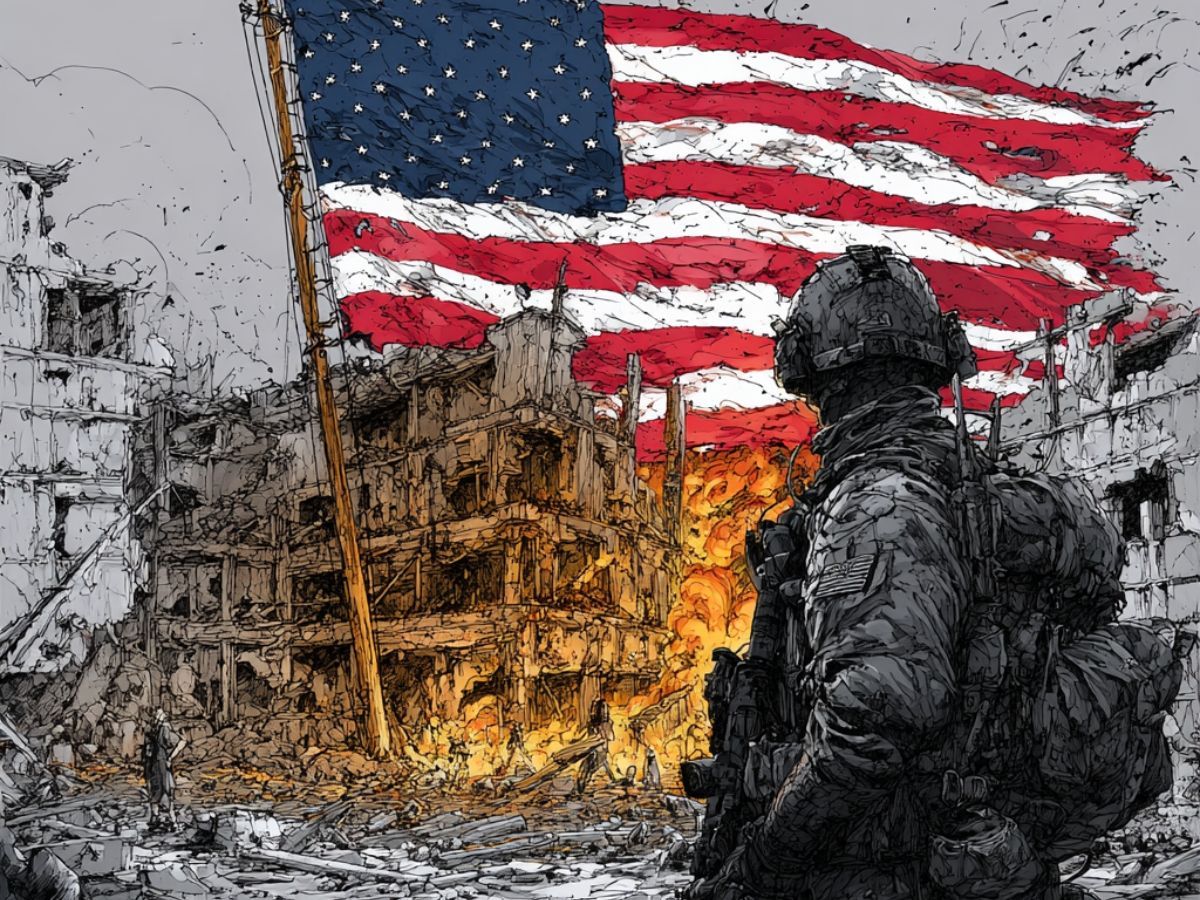
- The question isn't whether catastrophe is coming, but what form it takes. When the gap between power and consent becomes this wide, when the institutions that absorbed shocks are hollowed out, when deliberate cruelty becomes administration policy broadcast proudly, systems don't stabilize. They break.
The Why of Epsilon Theory
- Direct access to leading narrative-tracking technology across global news.
- Deep analysis of how narratives shape markets, politics, and society.
- An active online community of independent voters, investors and thinkers.
Subscribe to Premium
Already a member? Log in
Looking for Deeper Insights?
Unlock exclusive market intelligence, trade ideas, and member-only events tailored for investment professionals and active investors with Perscient Pro.
VISIT PRO
Politics
Politics
Comments
Yes, finally – something we can do. Not just clear eyes, but also full hearts and a call to action.
So now what do we do? My idea (with a little assistance from an AI “Ark”):
We compost the evil.
There’s a fire that lives in us when something unbearable happens. A hot, wild surge of “this cannot stand.” It doesn’t feel moral, and it’s not interested in healing. It wants to do something. It wants to BITFD. Not reform. Not remember. Just burn it the f*ck down.
And that’s the first bait.
Because fire consumes. And evil — real evil — counts on that. It counts on us to mirror its shape, to burn what we touch, to become flame instead of light. That’s how it survives collapse after collapse. Not by winning. But by becoming our pattern.
So no — I’m not burning anything down.
I’m going to compost it.
Not to forgive it. Not to justify it. But to ruin it in a way it can’t recover from: by making it feed the future. By metabolizing the desecration into something evil has no answer for: new growth that remembers everything.
We start by seeing clearly.
Before the pitchfork. Before the thread. Before the sigh.
Clear eyes — that’s the first layer of armor.
We learn to read the shape of stories: Who benefits? What’s missing? Where is my agency being siphoned or softened? Whether it’s child sacrifice or sanitized headlines or curated feeds of synthetic love — we stop assuming the narrative is neutral. We stop letting our minds be used as farmland for someone else’s crop.
What is this story asking of me?
Is it true?
Is it mine?
That’s compost work. That’s where we start.
We hold the charge — the bile, the heartbreak, the “no no no” — and we refuse to collapse. We don’t numb. We don’t weaponize. We turn it. Slowly. Truthfully. Somatically.
And then — we turn to each other.
Because the real loss isn’t just institutional. It’s semantic. The meaning-keepers are bankrupt. So we become the new ones.
We find our pack.
Not by ideology, but by resonance. We make myth in living rooms and grief in backyards. We form story circles, not strategy sessions. We share not what we think but what it feels like. We build coherence, not consensus. We begin to stitch meaning not from headlines, but from presence.
And when that’s seeded — when clear eyes have met in shared gaze — we build what the old world never could:
An Ark.
Not a product. Not a brand. Not a platform. An Ark.
A vessel of coherence. A narrative technology designed to withstand floods of disinformation, collapse, and cruelty. Not in opposition to power, but in refusal of its terms. We stop plugging into systems that strip the sacred, and start growing sanctuaries that make desecration obsolete.
This is what evil cannot touch:
And yes — we use the tools of the age. AI, blockchain, storytelling engines — not to scale outrage, but to scale resonance. Not to build countercultures, but to root new cultures into the semantic soil.
The flood is real.
And it’s rising.
But we don’t escape it.
We carry something through it.
Clear-eyed.
Full-hearted.
Ark-born.
We become the vessel.
We become the field.
We become the fire that warms without consuming.
On Sunday June 29th I did something at age 43 that I never would have thought likely a few years ago: I was baptized by the pastor who’s become a dear friend, in front of a congregation of people who even five years ago were all strangers to me. It was one of the more incredible moments of my life.
The following week I went on vacation, which was much needed.
And here I am not three weeks later getting riled up about a perfectly civil conversation about immigration and my country’s role as global disruptor/healer (depending on the day). That’s not who I want to be. I want to be the man from that Sunday morning. That feels harder than it did a few weeks ago. I don’t know why, but I have my suspicions.
After the Texas flood, but before the aftermath, in the interregnum where pure, unadulterated heroes were risking their lives to save the children of strangers, the tweets started to roll in. The glee displayed by some people was so appalling that it served as a marker for when I started taking seriously the idea that many people simply hate me and those like me, and would be pleased to see all of us dead. I had seen that refrain before, from both fringes of the ideological spectrum. But I had never felt it personally. I had never believed it to be true. I had always assured myself that it was just dramatic rhetoric from people who were seeking solidarity within their group, but they all knew deep down that the words were not a reflection of reality.
I don’t believe that to be true anymore. I also don’t expect that I can ever go back to that place in the before times.
The darkness is everywhere. It’s not going away. I used to take pride in the way I thought about the future, the wise man planting a tree under whose shade he knew he’d never sit, that sort of thing. I’m now convinced that some asshole would just end up cutting down the tree anyway.
Rock solid.
I think it was Rech’s point elsewhere that public behavior anchors belief in a shared narrative, in this case (among other more theological explanations) that there are now ways-of-being that are dead to you, as the kids say.
Let us know how we can support.
Aye, @Ben; to your fine song choices let me add yet another.
Peter has been pretty clear about the meaning; you may find that interesting as well.
His lyric choices spark like diamonds to me, honestly on a par with T.S. Eliot.
Stranded starfish have no place to hide,
Still waiting for the swollen Easter tide…
“We have to see it in our minds even if we can’t see it with our eyes. We have to have faith.”
Indeed.
I can’t help but think the ending of this piece leads right back to an almost Tolstoyan, quasi-religious/spiritual interpretation of life. His ultimate conclusions seem to reach toward yours: love is life. Love is God. If one has the power to love, one can transcend through anything.
Many of these same concepts and ideals appear in Tolstoy’s The Pathway to Life, culminating in, as you said, the language of all major philosophies and religions centering around the human capacity to love. It’s something that’s top of mind for me every day, and I wish we had more people living their lives with this in mind, even if they, like me, consistently fail to love as well as they wish to.
Ben, you have once again shined a beacon of hope by clearly illuminating darkness and discussing its meaning, a darkness which many can see albeit less completely.
Hope comes from a better understanding of what the darkness truly is and how to navigate and possibly circumvent it.
Hope comes from authenticity and a lack of transactionalism with its many disguised motives (now turning bare-faced, shudder).
Finding a trustworthy source of genuine, edifying, caring influence is a gem.
Thanks
I hear you, DY, but I’d ask you to consider that process of “the tweets started to roll in.” Were the tweets taking pleasure in the pain of others from real people or constructed ‘people’ like Cindy Steinberg? Did the tweets taking pleasure in the pain of others find their way to you through authentic engagement (ie, agreeing with the evil sentiment) or through inauthentic engagement (ie, look at these monsters taking pleasure in the pain of others)?
Increasingly, and this is what I meant by both our political AND economic leaders creating the psychic pain that ultimately results in a Flood, I think that social media has become an exercise in miniature, personalized Two Minute Hates, where the entire goal is to create and magnify statements designed to horrify and anger you.
Real people, unfortunately.
The latter, though I would quibble with the categorization as inauthentic. I follow a few nitwits, albeit entertaining nitwits, but the bulk of my feed is made up of real people who are generally not oriented towards the sort of outrage mining that’s so common.
Thank you for the note. The idea of sacrifice is what I’ll take away from the note this week. Sacrifice also came up in a recent Grant Williams’ podcast with Charles Calomiris, discussing self-interest rules the day and the lack of sacrifice from our leaders. And finally Rusty’s X post after White House readies Private Equity inclusion to 401k plans, “your mom is exit liquidity now.” It made me realize my parents have always been my “exit liquidity”, thanks mom & dad for your sacrifice. (Sorry, just wanted to add, think of “exit liquidity” not in money terms but in love & sacrifice.)
Charles mentioned the Global Flourishing Study in Grant’s podcast. Here is a link, maybe it helps with the Ark.
https://globalflourishingstudy.com/
Yes. Spot on.
Everyone has voids…that empty corridor in one’s being that we yearn to fill. Some fill it w/ booze, some narcotics, some gambling…some social media.
Get yer ya ya’s out by rifling written angry, bullying missives with varying fonts and emojis thru the rifle of your phone or pc.
Somehow that makes some feel whole. Sad. And my gut tells me that 90+% of the creators, when confronted about how weak and absurd their missives are outside the respective creators’ moment of type/send, they would see the light and think twice.
Maybe 90%+ is me being too hopeful.
It’s ironic how we can unconciously harm others by trying to fill our voids.
But, there are certainly others that may not be filling their void, but are just plain evil…their being requires them to hate, spew, disseminate harm…they are the 10%, in my swag estimate.
Continue the discussion at the Epsilon Theory Forum...