
Policies and Issues Pulse
The Pulse
October 7, 2026·Policies & Issues Pulse

Executive Summary
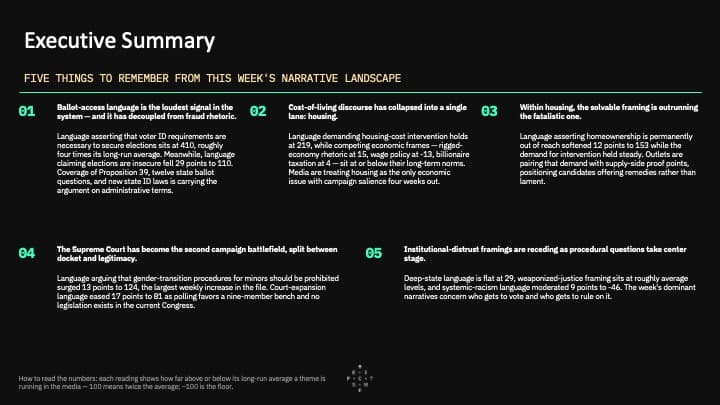
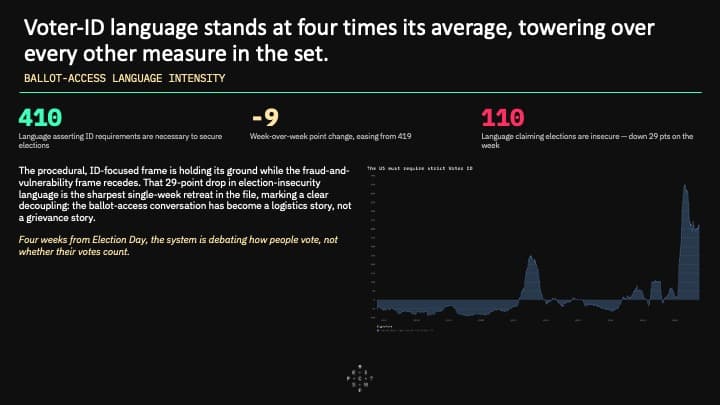
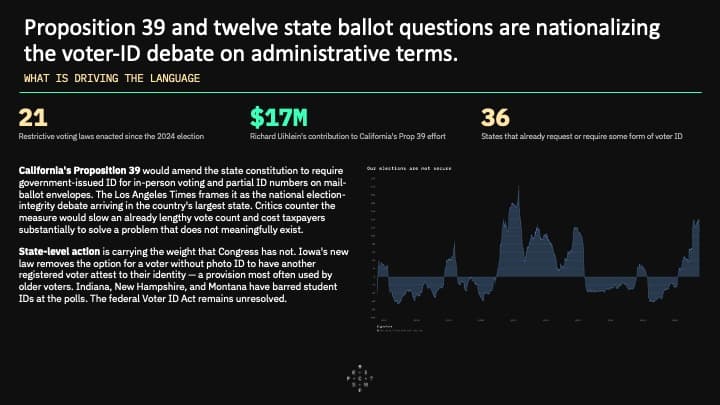
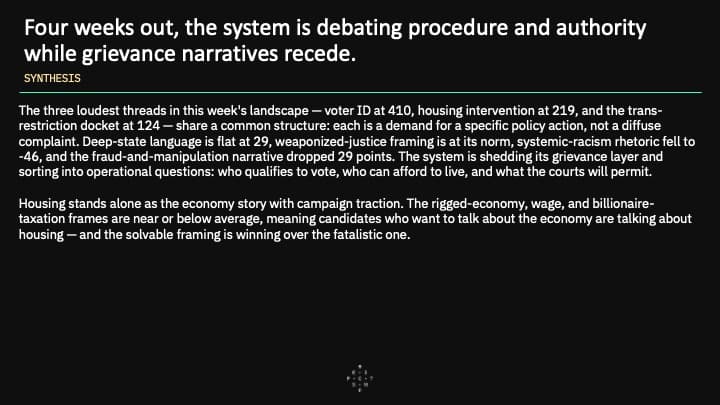
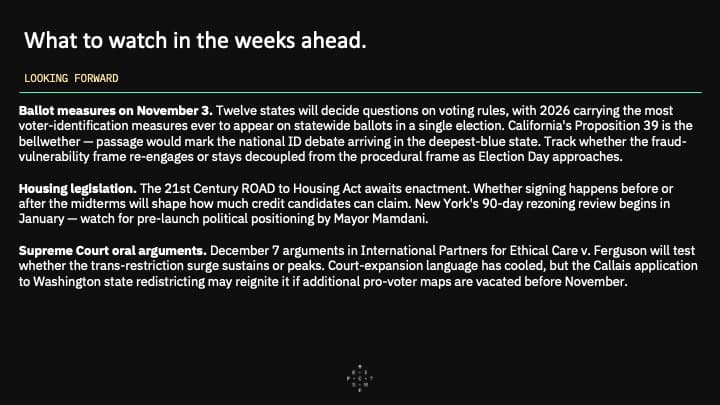
- Procedural election-integrity framing is the loudest narrative in the system heading into the final four weeks, and it has decoupled from fraud rhetoric. Perscient's semantic signature tracking the density of language asserting that identification requirements are necessary to secure elections remains the densest in the set, while language claiming that American elections are insecure or vulnerable to manipulation posted the sharpest weekly retreat in the file. Coverage of California's Proposition 39, twelve state ballot questions, and newly enacted state ID laws is carrying the argument on administrative, rules-based terms rather than on allegations of stolen elections — a framing shift that makes ballot access a logistics story rather than a grievance story.
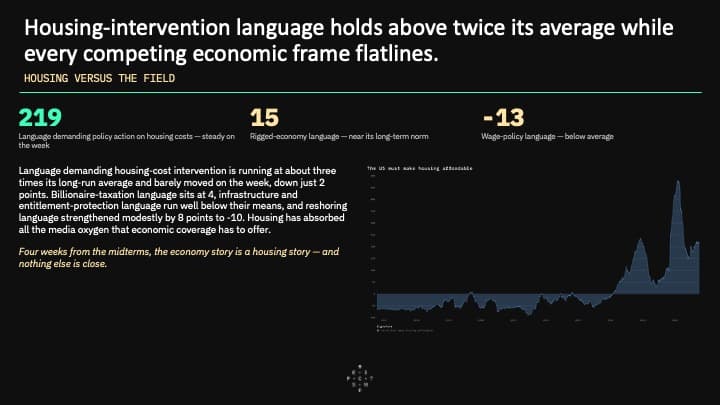
- Cost-of-living coverage has collapsed into a single lane: housing. Language demanding policy intervention on housing costs is holding steady and far above its baseline, while competing economic frames — rigged-economy rhetoric, wage policy, billionaire taxation, infrastructure, and entitlement protection — sit at or below their long-term norms. Reshoring and manufacturing-restoration language picked up modestly. Media are treating housing as the only economic issue with campaign salience four weeks out.
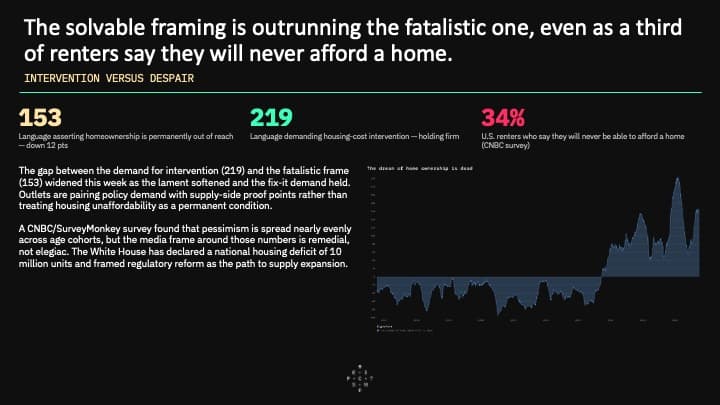
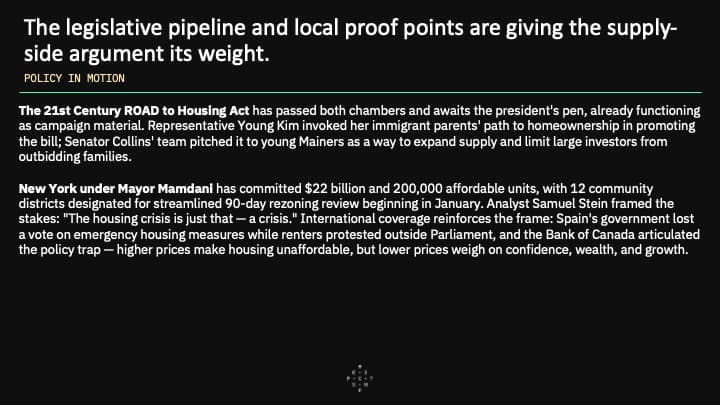
- Within housing, the solvable framing is outrunning the fatalistic one. Language asserting that homeownership is permanently out of reach softened, while the demand for intervention did not, even though survey coverage highlights that a third of renters believe that they will never afford a home. Outlets are pairing that demand with supply-side proof points — the 21st Century ROAD to Housing Act awaiting signature, White House deregulation claims, New York's fast-tracked rezoning under Mamdani, and cautionary cases from Spain and Canada — which positions candidates offering remedies rather than lament.
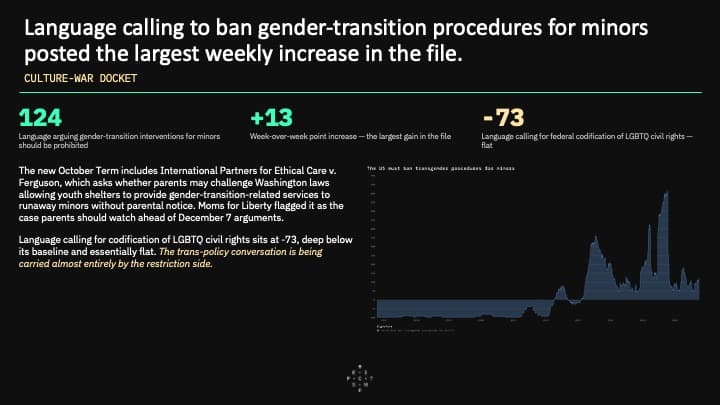
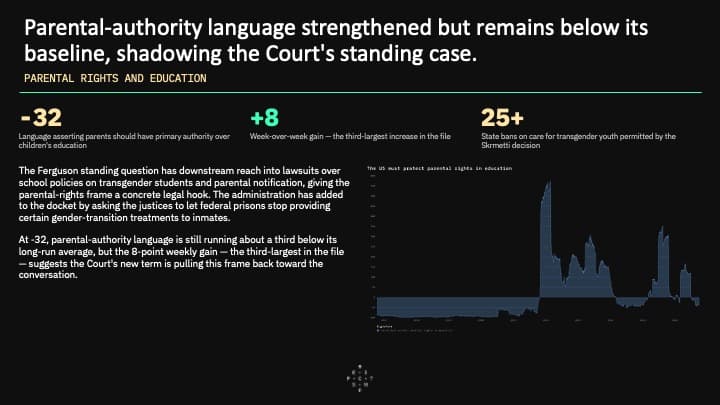
- The Supreme Court has become the second campaign battlefield, split between its docket and its legitimacy. Language arguing that medical gender transition for minors should be prohibited recorded the largest weekly increase in the file, driven by the new term's parental-rights standing case, while language calling for federal codification of LGBTQ civil rights stayed flat — leaving the trans-policy conversation carried almost entirely by the restriction side. Parental-authority language also strengthened, though it remains below its baseline.
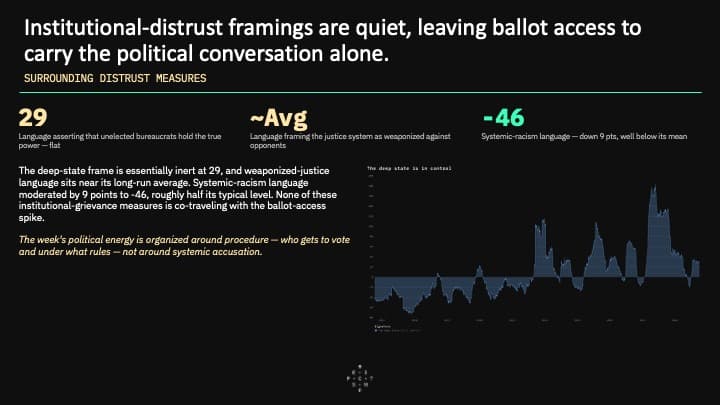
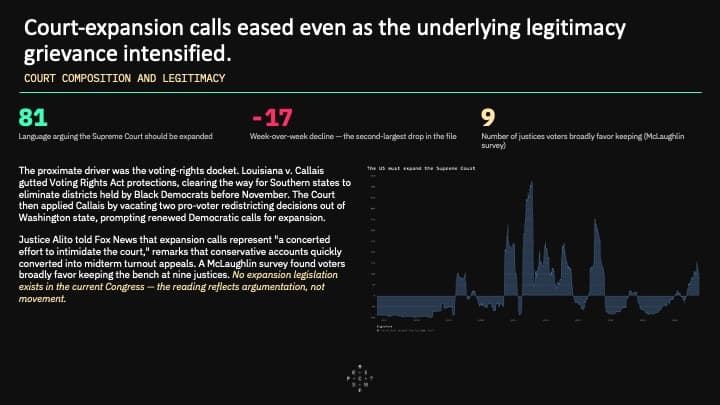
- Court-expansion argument cooled even as the underlying grievance intensified, revealing a gap between media volume and political viability. Calls to add justices eased after the Louisiana v. Callais fallout and its application to Washington state redistricting, with Justice Alito's "intimidate the court" remarks and polling favoring a nine-member bench pushing back. No expansion legislation exists in the current Congress, so the signature reflects rhetoric rather than movement. Taken together with the ballot-access and voting-rights threads, the week's dominant narratives concern who gets to vote and who gets to rule on it — while systemic-racism and weaponized-justice framings recede from the conversation.
Last updated: ...
Last updated: ...